
As an important lighting equipment in swimming places, it is crucial for pool lights to work safely and stably. In order to ensure that the pool light can emit light stably underwater and meet the safety standards, the transformer plays a vital role in the AC circuit. In this article, we will discuss in detail the specific requirements of pool light transformers from the voltage requirements, power matching, protection level, installation location and requirements, cable configuration and other aspects of the pool light transformer.
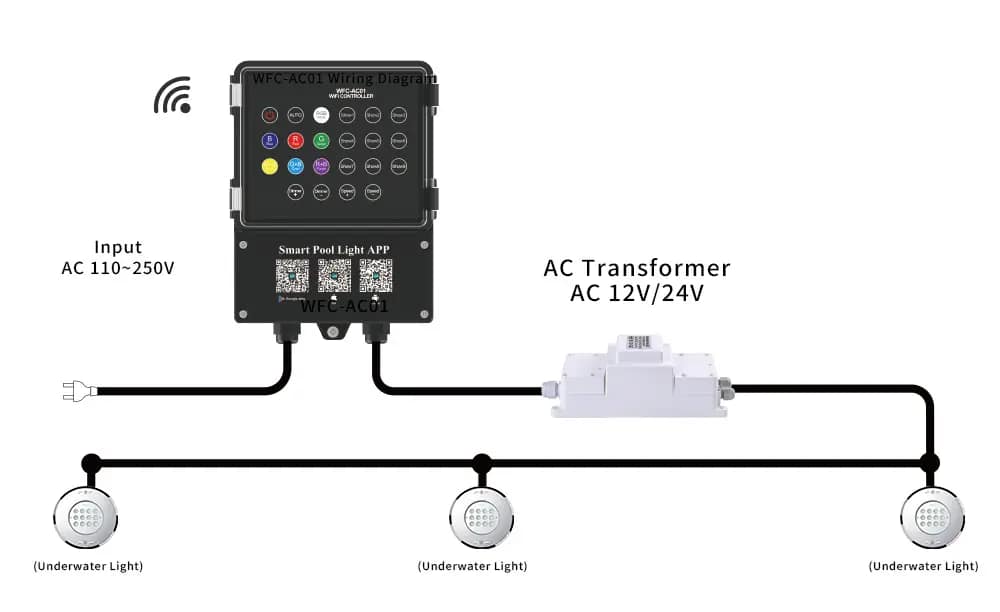
The voltage of swimming pool lights is usually designed as low voltage 12V or 24V to ensure the safety of use. This is because if the voltage is too high, not only will burn out the lamps, there is also a leakage of electric shock safety hazards; and if the voltage is too low, it may lead to insufficient brightness or lamps can not work properly. Therefore, pool lights must be converted to a low voltage suitable for underwater light work through a transformer.
Transformer power matching is the key to ensure the normal operation of pool lights. In order to ensure that all lamps and lanterns can get a stable voltage supply, the total power of the transformer is recommended to be designed for all the lamps and lanterns to be powered by the total power of 130%. This design margin ensures that the fixtures will function properly in the event of voltage fluctuations or line losses.
For example, if a swimming pool has ten 10W underwater lamps with a total power of 100W, the theoretical power of the transformer selected should be 130%, i.e. 130 W. In practice, a maximum power transformer close to or exceeding the calculated value, e.g. 150 W, is usually selected to ensure adequate power supply. If the transformer is not powerful enough, it will affect the lighting effect of the light.
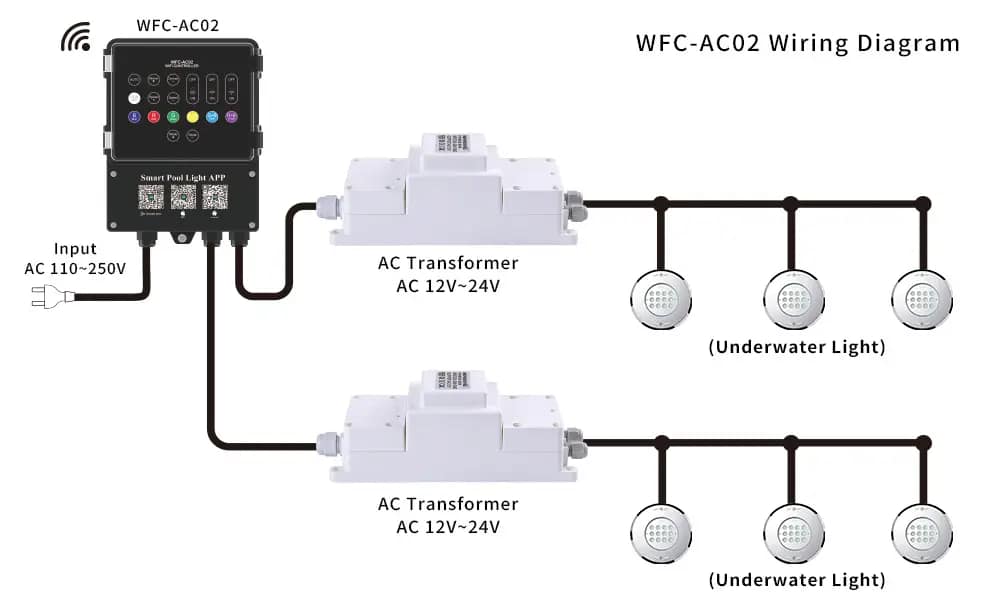
If there are too many lights for the load of a single transformer, multiple transformers can be used in paralle.
The protection level of the pool light transformer depends on its installation conditions. If the transformer is independently installed in the outdoor, its protection level should reach the outdoor use standard, at least IP65, to ensure waterproof and dustproof performance.
Waterproof transformers usually have a waterproof rating of IP67 or higher to ensure that they can still function properly in the event of splashing or flooding.
IP Rating for Underwater Lights
In addition, the transformer shell material should have good corrosion resistance and weather resistance to adapt to the complex and changing outdoor environmental conditions. Some high-end transformers will also use special heat dissipation design to improve its working stability and service life.
The installation location of the pool light transformer has a significant impact on its efficiency and safety. The position of the transformer or junction box should be at least 10cm above the horizontal plane and at least 120cm away from the pool wall to prevent safety hazards caused by water splashing or flooding.

Meanwhile, the length of the wire connecting the pool light and the transformer should preferably not exceed 30 meters (100 ft) to avoid voltage loss and unstable operation of the fixture caused by the excessively long wire.
When installing the transformer, its ventilation and heat dissipation conditions should also be considered. The transformer will generate a certain amount of heat during the working process, and if the heat dissipation is poor, it may lead to high temperature, affecting the working efficiency and service life. Therefore, when installing the transformer, it should be ensured that there is enough space around the transformer for heat dissipation, and avoid close proximity to other objects or accumulation of debris.
The configuration of the cable line is equally important for the normal operation of the pool light transformer. The choice of cable line should be based on the current size and line length to determine. Usually, the larger the wire diameter of the cable line, the smaller the resistance and the smaller the voltage loss. Therefore, when selecting cable lines, the current of each lamp should be calculated according to the power and voltage of each lamp, and then multiplied by the number of lamps to get the total current. Finally, select the appropriate cable wire specification according to the total current and line length.
In actual construction, a main cable is usually used to pull to the location of each lamp, and then split to the underwater lamp. The relationship between each underwater light is in parallel, which can ensure that each light can get a stable voltage supply. At the same time, the wire diameter of the main cable should be determined according to the total current, and selected according to the principle of the proximity of the larger one, in order to ensure sufficient current supply and voltage stability.
In addition, the joint treatment of the cable line is also very important. The joints should use professional waterproof connector or waterproof junction box, and sealing treatment after the completion of wiring to prevent moisture from entering to cause cable line aging or damage. For cable wires that have been immersed in water for a long time, high-quality materials with corrosion and aging resistance should also be selected.
In addition to the above requirements, a number of additional measures can be taken to enhance the safety of pool light circuits. For example, pool light circuit systems may also be equipped with ground-fault circuit interrupters (GFCI) with circuit breakers of appropriate current ratings to ensure that power can be shut off in the event of a leakage or a short circuit in time to avoid electric shock.
During installation and use, one should regularly inspect and maintain the transformer. The inspection should cover items such as checking if the connectors of the cable line are loose or aging, if the transformer’s shell is broken or deformed, and if the cooling fan is functioning properly. If any problems are found, one should promptly address them or replace the affected parts to ensure the transformer operates normally and safely.
To summarize, pool light transformers play a vital role in pool lighting systems. In order to ensure the safe, stable and efficient work of pool lights, the transformer should meet the requirements of voltage requirements, power matching, protection level, installation location and requirements, cable configuration and other aspects. At the same time, in the process of installation and use, attention should also be paid to regular inspection and maintenance to ensure the long-term stable operation of the transformer.
Through the rational selection and use of transformers, not only can improve the efficiency and lighting effect of pool lights, but also reduce energy consumption and maintenance costs, providing a safer, more comfortable and beautiful lighting environment for swimming places. Therefore, when designing and installing the pool lighting system, the selection and configuration requirements of the transformer should be fully considered to ensure the reliability and safety of the whole system.

 EN
 ES
 FR
 ID