
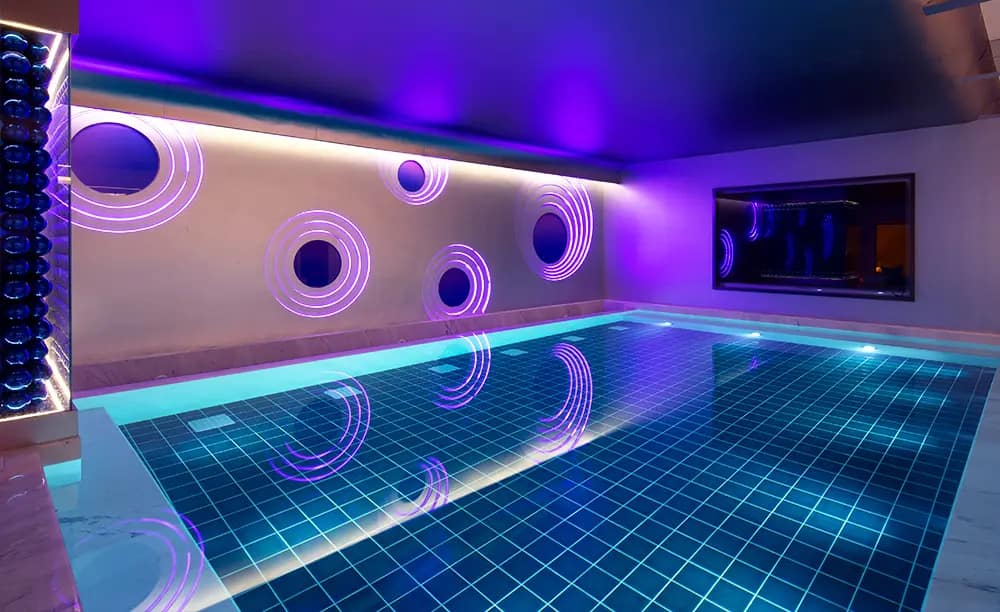
Pool lights available on the market today fall into three main categories: traditional halogen lights, LED lights, and fiber optic lighting systems. Each type offers distinct advantages and suits different application scenarios.
Traditional halogen lamps were the mainstream choice for early pool lighting due to their high brightness and relatively low cost. However, they usually consume high power—often several hundred watts—and are less energy-efficient with a comparatively short lifespan.
LED pool lights represent a newer lighting solution that has developed rapidly in recent years. Available in a wide power range (from a few watts to 100 watts), they offer high energy efficiency, long life, adjustable color, and other significant benefits, making them the top choice for modern pool lighting.
Fiber optic lighting systems are especially suitable for pools requiring a special atmosphere or complex shapes. Although the fiber optic cables themselves don’t use power, the light source generator’s power must still be considered in the overall lighting plan.
Significant differences exist in power requirements among these pool light types. Understanding these variations is essential for making a scientific power selection.
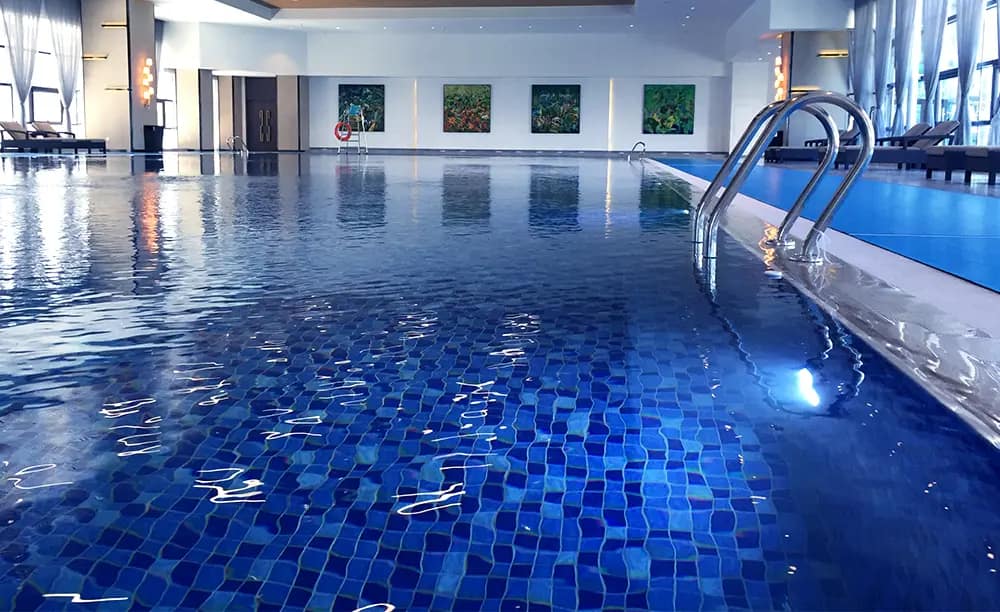
The intended purpose and desired atmosphere of pool lighting directly influence fixture power selection. Different scenarios—such as functional lighting, decorative lighting, or safety warning lighting—require varying levels of brightness, color temperature, and light distribution. Thus, identifying the primary use and atmospheric goal is critical when determining pool light wattage
For pools mainly used for swim training, competitions, or frequent nighttime activity, functional lighting is a primary concern. These applications demand even illumination and sufficient brightness across the pool area to ensure safety and visibility.
For private pools, resort hotels, or landscape pools, the lighting primarily aims to create ambiance rather than provide high-intensity functional lighting. These settings typically employ variable color temperature and RGB dynamic lighting to enhance visual effects.
In public pools or deep-water areas, safety warning lighting is especially important. Low-power fixtures with high color rendering (CRI > 90) are often used here to help lifeguards and swimmers clearly see underwater conditions.
Pool size is the primary factor in determining light power. In general, larger surface areas require higher power. For standard rectangular pools, a rough estimate can be made using 2–3 watts of LED power per square meter. Depth is equally important—deeper pools need higher-power fixtures to ensure adequate brightness at the bottom. For instance, a 1.5-meter-deep pool might only need 30–50-watt LED lights, while a 3-meter-deep pool could require 75–100 watts to achieve the same effect.
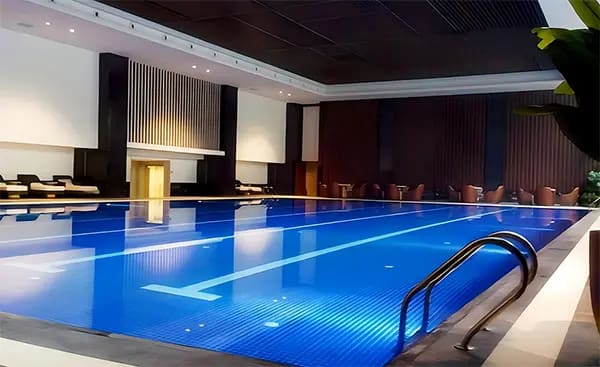
The usage environment also affects power choice. Indoor pools usually allow for lower-power fixtures since enclosed structures reflect and retain light. Outdoor pools, by contrast, must compensate for ambient light interference and often need higher-power fixtures to ensure safe nighttime use. Additionally, the pool’s purpose should be considered. Small private pools meant for relaxation may emphasize ambiance, permitting lower-power LED systems with rich color options. Standard pools designed for competition or training require uniform, bright functional lighting and typically need higher-power fixtures.
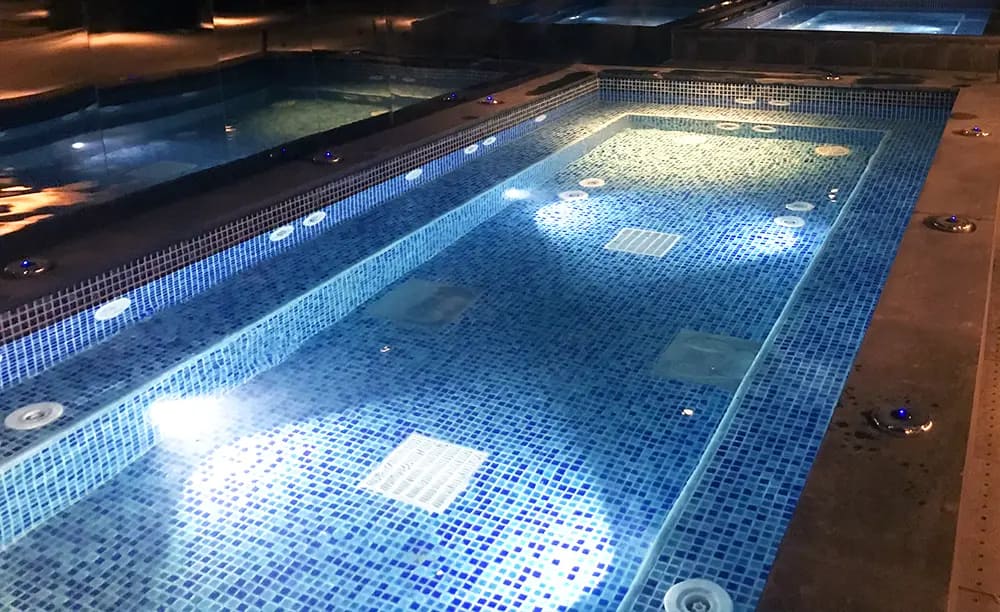
Lighting effect is typically measured in illuminance (lux) and luminous flux (lumens), which relate directly to power (watts). In traditional lighting, higher power usually meant higher brightness. With LEDs, however, the relationship is more complex due to varying luminous efficacy (lumens per watt) across products. High-quality LED pool lights can exceed 100 lm/W, while lower-quality ones may only reach 50 lm/W. This means a 30-watt high-efficiency LED may outperform a 50-watt low-efficiency model.
Uniformity is another key metric. It depends on fixture arrangement and power distribution. Overpowered single lights may create localized glare and leave other areas too dark. In contrast, several medium- to low-power lamps arranged properly often achieve better overall uniformity. Color temperature also influences perceived brightness: cooler tones (e.g., 6000K) typically appear brighter than warmer ones (e.g., 3000K), even with the same luminous flux.
With growing environmental awareness, energy efficiency has become a key factor in selecting pool light power. LED technology is already over 70% more efficient than traditional lighting, but power selection still demands care. Excessively high power wastes energy and may cause glare; insufficient power compromises safety. Smart control systems can balance efficiency and function—for example, by using light sensors to auto-adjust brightness or offering scene-based modes to accommodate different needs.
Solar-powered pool lights offer another efficient option, especially in sunny regions. Although typically lower in power, proper layout and energy storage design can still meet basic lighting requirements. Additionally, high IP-rated fixtures (such as IP68) may have higher upfront costs, but their longer lifespan and stable performance often lead to greater energy savings and cost efficiency over time.
Pool lighting technology continues to evolve toward smarter, more energy-efficient solutions. Variable-power fixtures are growing more common, allowing users to adjust brightness based on actual needs, saving energy while adapting to various scenarios. IoT integration enables remote monitoring and adaptive lighting, with systems that automatically optimize power using usage patterns, ambient light, and even weather forecasts.
Selecting the right power for pool lights involves balancing multiple factors—lighting objectives, technical parameters, practical needs, and environmental conditions. As technology advances and environmental standards tighten, the value of appropriate power selection will only increase. Pool owners and designers are advised to not only address current requirements but also allow for future upgrades, achieving an optimal balance among functionality, aesthetics, and sustainability.

 EN
EN  ES
ES  FR
FR  ID
ID